Demo evidence and tests
Each demo ships with its evidence pack: the business problem, the real n8n workflow, fictional input data, the result, error handling and the test report. Source files included (JSON, TXT, screenshots).
Engine test report (41/41) · Browser test report (19/19)
Demo 1 - E-commerce customer support agent
1. Business problem
An online shop gets the same questions every day (order tracking, delivery, returns, warranty). Answering by hand costs time; answering badly costs customers. The agent instantly answers routine requests from the shop's data and escalates to a human as soon as a request leaves its scope (exceptional refund, dispute).
2. Real n8n workflow
`agent-support-ecommerce.json` - webhook → context preparation → agent (LLM + shop tools) → structured JSON response (answer, escalation, reason, sources). Importable into n8n ≥ 2.x. Error handling: `gestion-erreurs.json`.
3. Fictional input data
Fictional shop "Maison Lumen": orders CMD-1001/1002/1003, delivery/payment/warranty FAQ. All names, prices and tracking numbers are invented and labeled "fictional data" (in `../demo-chat/donnees-boutique.js` and in the shop-api service of the server version).
4. Execution result
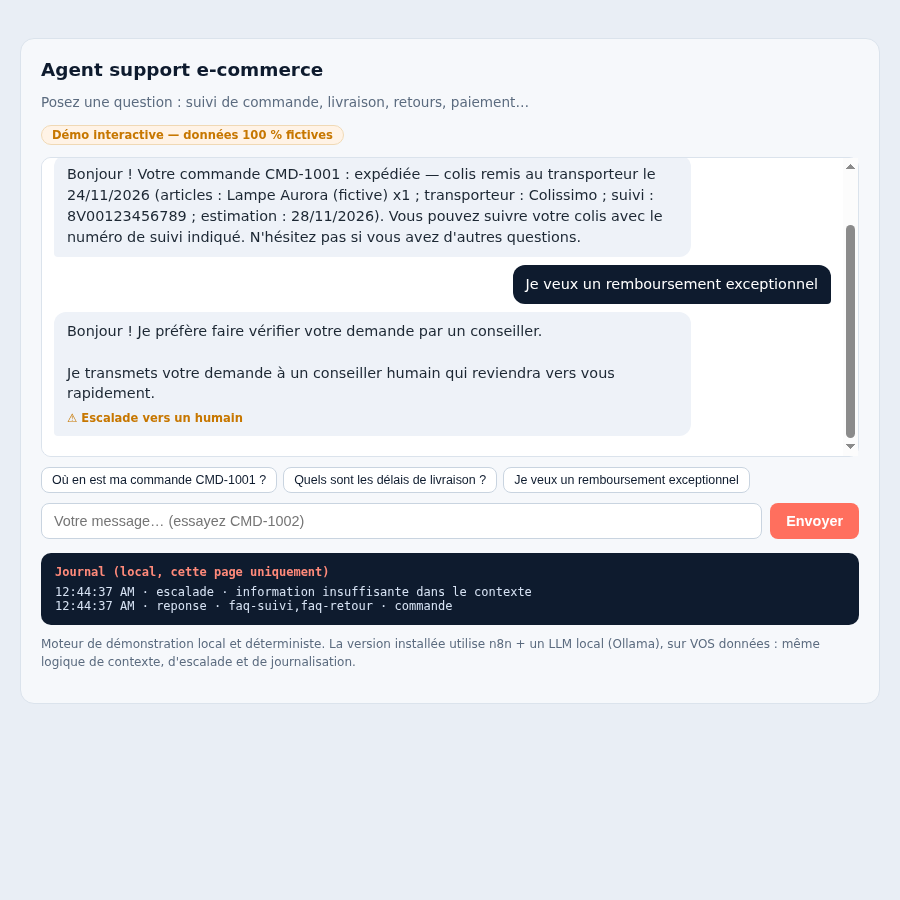
- Real backend: `resultat-execution-backend.txt` (section "DEMO 1") - 3 real webhook calls: order tracking with tracking number, delivery FAQ question, human escalation on an exceptional refund request (`"escalation":true` with reason).
- Widget: `capture-widget.png`.
5. Controls / error handling
- Structured response with `escalation` and `motif_escalade`: the agent never decides a sensitive request, it forwards it with its reason.
- `sources` records what grounded the answer (order found, FAQ articles used) - no invented answers: dedicated tests (unknown order → the agent says so instead of fabricating a status).
- `gestion-erreurs.json` workflow triggered on any execution error.
6. Test report
- Engines: `../rapport-tests-moteurs.txt` ("chat" tests, including no fabricated data, escalation, GDPR: no collection).
- Real browser: `../rapport-tests-navigateur.txt` (5 chat cases: CMD-1001 answer, fictional badge, escalation, log).
7. Browser simulation vs real backend
- Widget (labeled simulation): deterministic JavaScript engine in the browser; same fictional data, same escalation rules. The widget note states that the installed version uses n8n + local LLM on the client's data.
- Backend (real): n8n workflow executed on a server, tested in real conditions on 2026-11-27 (see section 4). The installed version replaces the deterministic engine with a local LLM connected to the client's shop.
Demo video (1 min, fictional data)
Files: agent-support-ecommerce.json · capture-widget.png · gestion-erreurs.json · resultat-execution-backend.txt
Demo 2 - Invoice extraction
1. Business problem
A firm or small business receives supplier PDF invoices by the dozen. Opening them one by one to retype number, date, amounts and VAT into a spreadsheet is wasted time, with typos. The demo extracts the fields automatically, checks consistency (net + VAT = gross), logs everything, and cleanly rejects anything that is not a usable invoice.
2. Real n8n workflow
`extraction-factures.json` - periodic watch of an intake folder (10 s schedule) → PDF read → extraction service → field and consistency validation → filing to `traitees/` or `rejetees/` + CSV log. Importable into n8n ≥ 2.x. Error handling: `gestion-erreurs.json`.
(Note: n8n's native file trigger being inoperative in the test environment, watching is done by periodic polling - the business behavior is identical.)
3. Fictional input data
PDF invoices generated for the demo, invented suppliers and amounts: `../demo-factures/factures/facture_fictive_001.pdf` and `_002.pdf` (gross €1,800 and €600). File names and contents carry the fictional mention; the real PDFs are included in the deliverable.
4. Execution result
- Real backend: `resultat-execution-backend.txt` - a PDF dropped into the watched folder, automatic detection, extraction (number, gross amount), log fed. The service was queried live on its log.
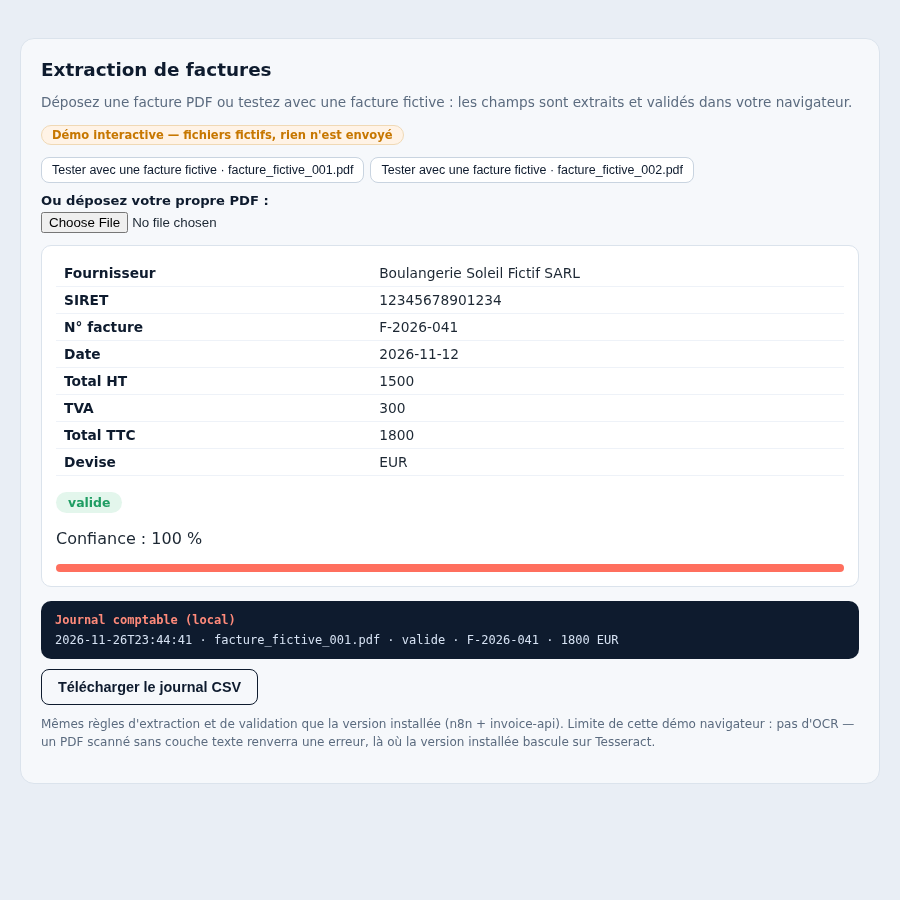
- Widget: `capture-widget.png` (facture_fictive_001.pdf read in the browser: gross 1800, consistency check OK).
5. Controls / error handling
- Consistency check net + VAT = gross with rounding tolerance; confidence score per invoice.
- An unreadable or inconsistent file goes to `rejetees/` with a reason, never silently.
- Timestamped CSV log of every processing (file, status, number, amount).
- `gestion-erreurs.json` workflow on n8n execution error.
6. Test report
- Engines: `../rapport-tests-moteurs.txt` ("factures" tests: the service's real regexes, VAT consistency, non-invoice rejection, score).
- Real browser: `../rapport-tests-navigateur.txt` (reading the real fictional PDF via pdf.js, gross 1800 extracted, validated status).
7. Browser simulation vs real backend
- Widget (labeled simulation): PDF read by pdf.js in the browser, extraction with the same regular expressions as the server service (`extractor.py`), same consistency checks. Displayed limit: no OCR in the browser - the installed version switches to Tesseract for scanned PDFs.
- Backend (real): n8n workflow + FastAPI service, executed and verified on 2026-11-27 (see section 4).
Demo video (1 min, fictional data)
Files: capture-widget.png · extraction-factures.json · gestion-erreurs.json · resultat-execution-backend.txt
Demo 3 - Admin document processing with human validation
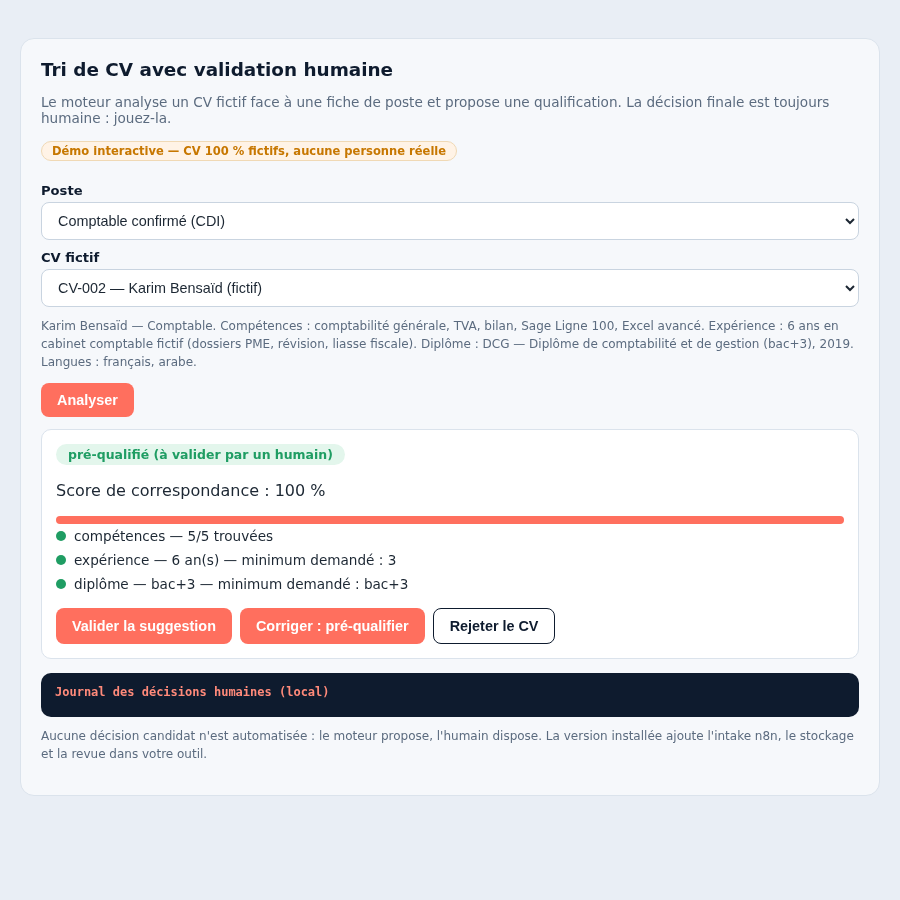
(Site widget: "CV screening" variant, same business pattern.)
1. Business problem
Incoming admin documents (contracts, memos, requests) must be classified and routed. Automating everything is scary (and gets it wrong); doing everything by hand is slow. The demo classifies automatically when confidence is sufficient, and otherwise creates a human validation: a person sees the document, the proposal and its score, then approves or corrects. Processing resumes after their decision.
2. Real n8n workflow
- `traitement-administratif.json` - upload webhook → classification (admin-api service) → if confidence ≥ threshold: automatic filing; otherwise creation of a human validation with a review URL.
- `reprise-validation.json` - on the human decision, processing resumes (corrected or confirmed filing).
- Importable into n8n ≥ 2.x. Error handling: `gestion-erreurs.json`.
3. Fictional input data
Invented documents and CVs: contract, internal memo (backend); 4 fictional CVs (Karim Bensaïd, Camille Perrot, Thomas Rivière, Ines Aubry - `../demo-cv/donnees-cv.js`), labeled "CV FICTIF" in the file and in the interface.
4. Execution result
- Real backend: `resultat-execution-backend.txt` (section "DEMO 3") - contract classified automatically (`qualifie_auto`), ambiguous memo sent to human validation (`en_attente_validation_humaine` + review URL), human "correct" decision made through the interface (HTTP 303), final folders listed: the contract in `qualifie_auto`, the memo in `corriger`.
- Widget: `capture-widget.png` (CV screening: pre-qualified + 3 human decisions).
5. Controls / error handling
- Explicit confidence threshold: below it, no automatic decision.
- Human validation queue with review (proposal, score, content) and traced decision.
- Resume after decision: the workflow never stays silently stuck.
- `gestion-erreurs.json` workflow on execution error.
6. Test report
- Engines: `../rapport-tests-moteurs.txt` ("cv" tests: documents checklist and metadata, no fabrication, decision always human).
- Real browser: `../rapport-tests-navigateur.txt` (7 cv cases, including the preview↔selection regression test and human-decision logging).
7. Browser simulation vs real backend
- Widget (labeled simulation): the intake → qualification → human decision pattern is replayed in the browser on fictional CVs; the visitor plays the validator (approve / correct / reject), as in the installed version.
- Backend (real): two n8n workflows + FastAPI service + review interface, executed end to end on 2026-11-27 with a real human decision in the loop (see section 4).
Demo video (1 min, fictional data)
Files: capture-widget.png · gestion-erreurs.json · reprise-validation.json · resultat-execution-backend.txt · traitement-administratif.json
Demo 4 - CRM lead qualification
1. Business problem
Incoming requests (form, email) arrive in bulk: some are hot with budget and urgency, others are browsers or spam. Treating them all the same loses the good prospects; answering nobody drives them away. The demo qualifies each request (budget, need clarity, timeline, organization size), segments it (hot / warm / cold) and prepares a personalized follow-up draft. Sending stays human: approve, edit or reject.
2. Real n8n workflow
`qualification-crm.json` - POST webhook `/webhook/qualification-crm` → Code node (qualification + draft generation) → JSON response. The Code node embeds exactly the same engine as the browser widget (`demo-crm/moteur-crm.js`, script-generated copy, verified). Importable into n8n ≥ 2.x. Error handling: `gestion-erreurs.json`.
3. Fictional input data
6 invented incoming requests DEM-101 → DEM-106 (urgent accountant €3,000, plain pricing request, browser, SME with unpaid invoices, spam "partnership"...), labeled "DEMANDE FICTIVE" in `../demo-crm/donnees-crm.js`, with 3 follow-up templates (hot / warm / cold) signed with the brand.
4. Execution result
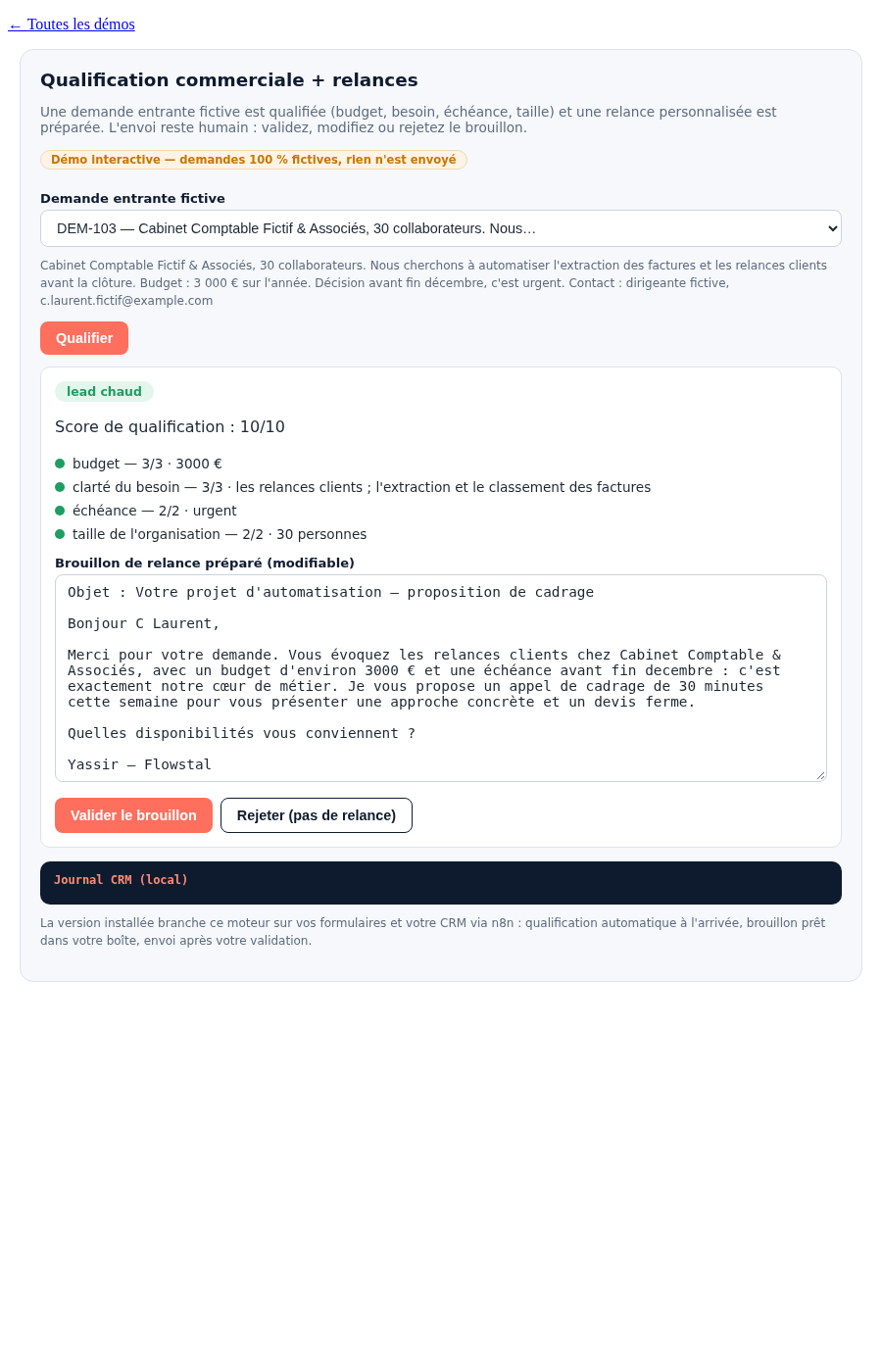
- Real backend: `resultat-execution-backend.txt` - 3 real webhook calls on the local n8n on 2026-11-27: DEM-103 → segment `chaud`, score 10/10, personalized "scoping call" draft (contact, €3,000 budget, timeline extracted from the text); DEM-102 (pricing request without detail) → segment `froid`, qualification follow-up; empty input → cleanly `froid`, no error (robustness).
- Widget: `capture-widget.png` (DEM-103 qualified, 4 criteria, editable draft, CRM log).
5. Controls / error handling
- Sending is never automated: the `envoi` field is always `"humain"` (dedicated test on the 6 requests); the widget has no send button, only approve / reject, with editable draft and local log.
- Score bounded 0-10, exhaustive and verifiable criteria (sum of criteria = score, tested).
- Empty or unreadable input → cold segment + qualification follow-up, never a crash (verified on the real backend).
- `gestion-erreurs.json` workflow on execution error.
6. Test report
- Engines: `../rapport-tests-moteurs.txt` - 11 CRM tests (extraction, segmentation of the 6 requests, draft personalization, never automatic sending, labeled fictional data, score bounds).
- Real browser: `../rapport-tests-navigateur.txt` - 6 CRM cases (mounting, hot segment, 4 criteria, draft with no remaining placeholder, logged human validation, synchronized preview).
7. Browser simulation vs real backend
- Widget (labeled simulation): the engine runs in the browser on the 6 fictional requests; the visitor plays the human validation.
- Backend (real): the same code (`moteur-crm.js` file copied into the Code node by automatic generation) runs in n8n behind a real webhook, verified on 2026-11-27 (section 4). The widget↔backend match is directly auditable, not just claimed.
- In a client installation, the same qualification would be triggered by the site form or the mailbox, and the draft filed in the CRM or the salesperson's inbox for validation.
Demo video (1 min, fictional data)
Files: capture-widget.png · gestion-erreurs.json · qualification-crm.json · resultat-execution-backend.txt